







- Home
- Molecular Biology and Plasmid DNA: From R&D to GMP
- Analytical services
Analytical services
From plasmid stability studies and capillary electrophoresis to genotyping, quality control, and full-length sequencing, we deliver reliable results to support the safety and success of your research, development, and production projects.
Plasmid stability studies
Early assessment of your plasmid helps anticipate variations that could compromise your project. It includes analyzing the behavior of plasmid DNA during bacterial culture, particularly the stability of the supercoiled form and the poly(A) sequence.
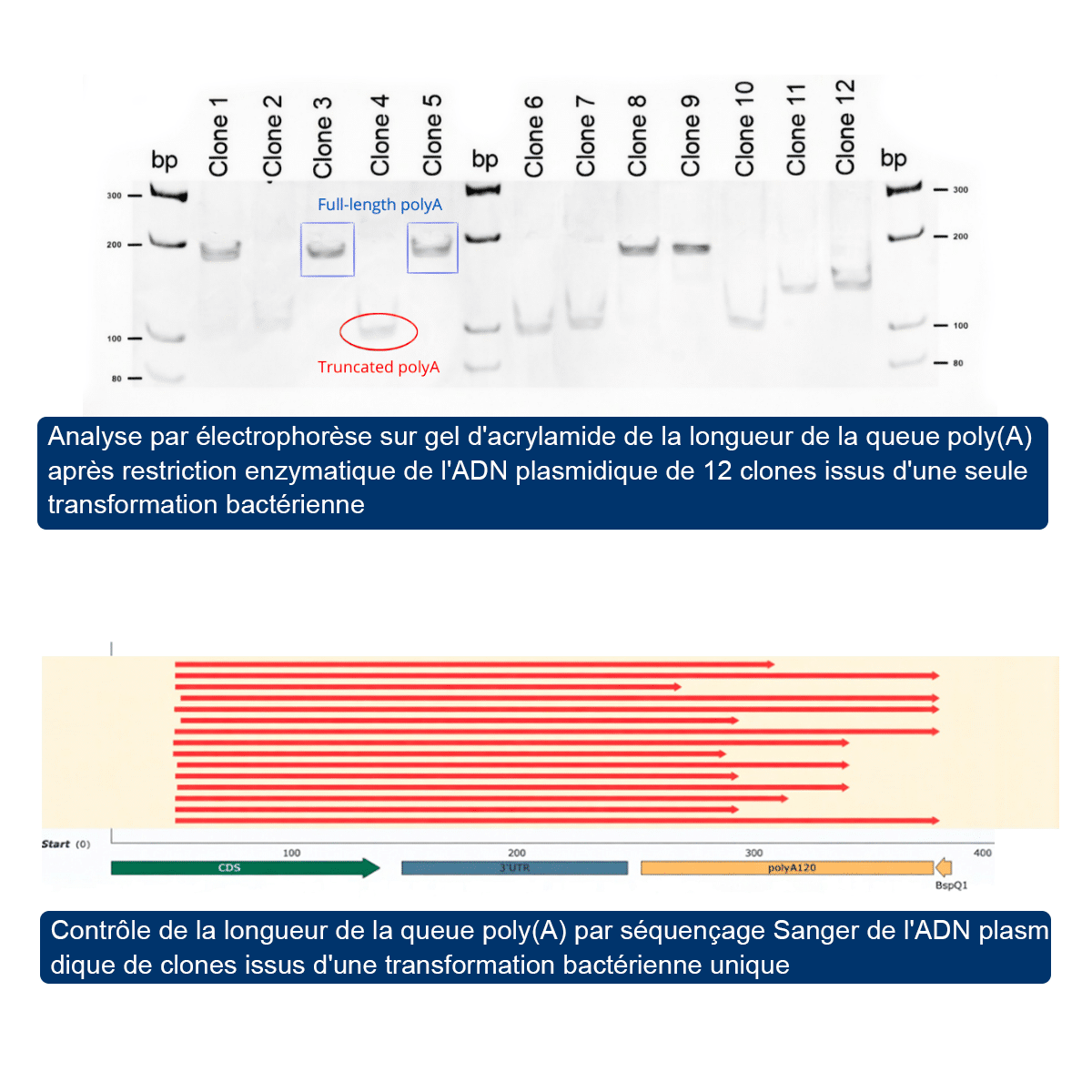
The success of mRNA-based therapies strongly depends on the integrity of the expression cassette, particularly the poly(A) tail. However, maintaining a stable poly(A) sequence during plasmid DNA amplification is a well-known challenge.
At RD-Biotech, we offer tailored stability studies to ensure that your plasmid constructs remain intact at every stage of bacterial culture.
To ensure the quality of your templates, we combine high-resolution techniques:
- restriction enzyme digestion and gel electrophoresis to visualize the size and homogeneity of the poly(A) tail;
- Sanger sequencing to determine the exact length of the poly(A) tail.
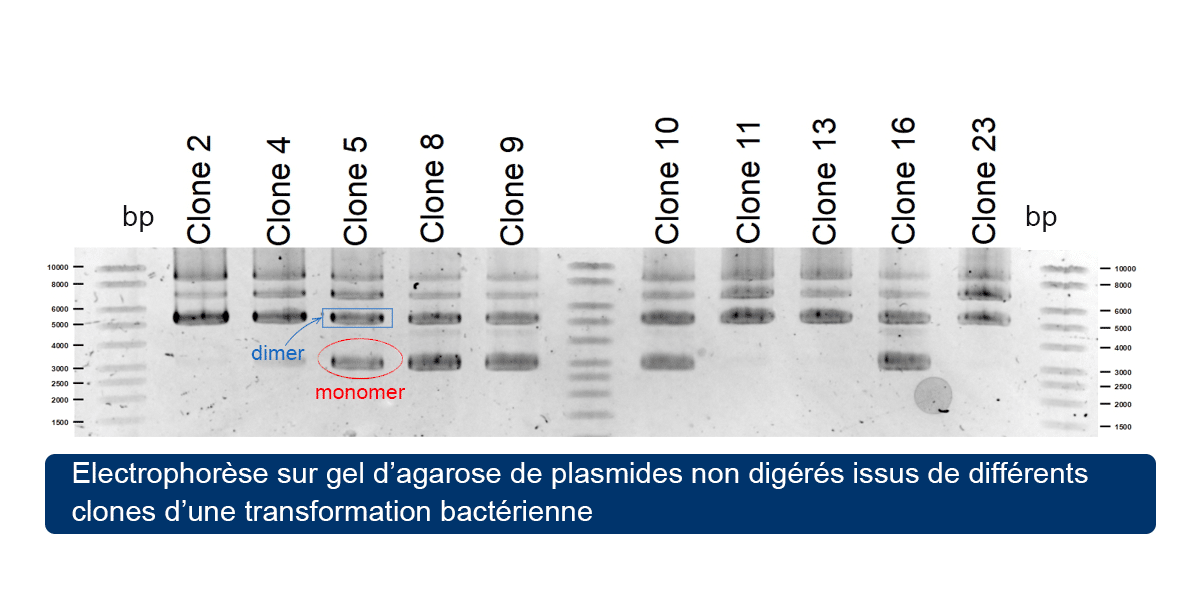
The supercoiled (CCC) form of plasmids is critical to the efficacy of gene therapies as well as mRNA-based therapies. During bacterial amplification, plasmids may undergo multimerization (forming dimers, trimers, and concatemeric forms) which leads to a loss of supercoiling and a significant reduction in both yield and final product quality.
At RD-Biotech, we provide tailored stability studies to ensure that the supercoiled form is maintained and to assess the risk of multimerization throughout the production process.
To accurately assess the topological quality of your plasmids, we can perform:
- agarose gel electrophoresis to separate and quantify supercoiled, open-circular, linear, and multimeric forms;
- capillary electrophoresis for precise quantitative analysis of the proportion of supercoiled monomers.
Chez RD-BIOTECH, nous proposons des études de stabilité adaptées pour garantir le maintien de la forme supercoiled et évaluer les risques de multimérisation tout au long du processus de production.
Pour évaluer avec précision la qualité topologique de vos plasmides, nous pouvons réaliser des analyses via :
- Électrophorèse sur gel d’agarose pour séparer et quantifier les formes supercoiled, open circular, linéaires et multimériques.
- Electrophorèse capillaire pour une analyse quantitative fine de la proportion de monomère supercoiled
Why test stability ?
Early assessment is the best way to anticipate, at every stage, variations that could affect the success of your project:
- Plasmid backbone development: assessing the stability of new plasmid constructs.
- Scale-up preparation: ensuring quality when transitioning to large-scale production.
- Process optimization: predicting and minimizing unwanted recombination depending on the strains or media used.
- Développement du backbone plasmidique : Évaluation de la stabilité de nouvelles constructions de plasmides.
- Préparation au scale-up : Garantir la qualité lors du passage à la production à grande échelle.
- Optimisation des procédés : Prédire et minimiser les recombinaisons indésirables selon les souches ou milieux utilisés.
The RD-Biotech advantage
- Extensive, well-established expertise in molecular biology and plasmid analysis, with a particular focus on poly(A) tail behavior and supercoiling levels.
- Reliable methods that deliver reproducible results for rigorous monitoring of your constructs.
- Data-driven results that directly improve and safeguard your production processes.
- Flexible services tailored to the specific needs of academic, biotechnology, and pharmaceutical projects.
Capillary gel electrophoresis
Capillary gel electrophoresis (CGE) is a precise analytical method for plasmid DNA quality control. Its high resolution enables clear differentiation between the various plasmid topologies and forms.
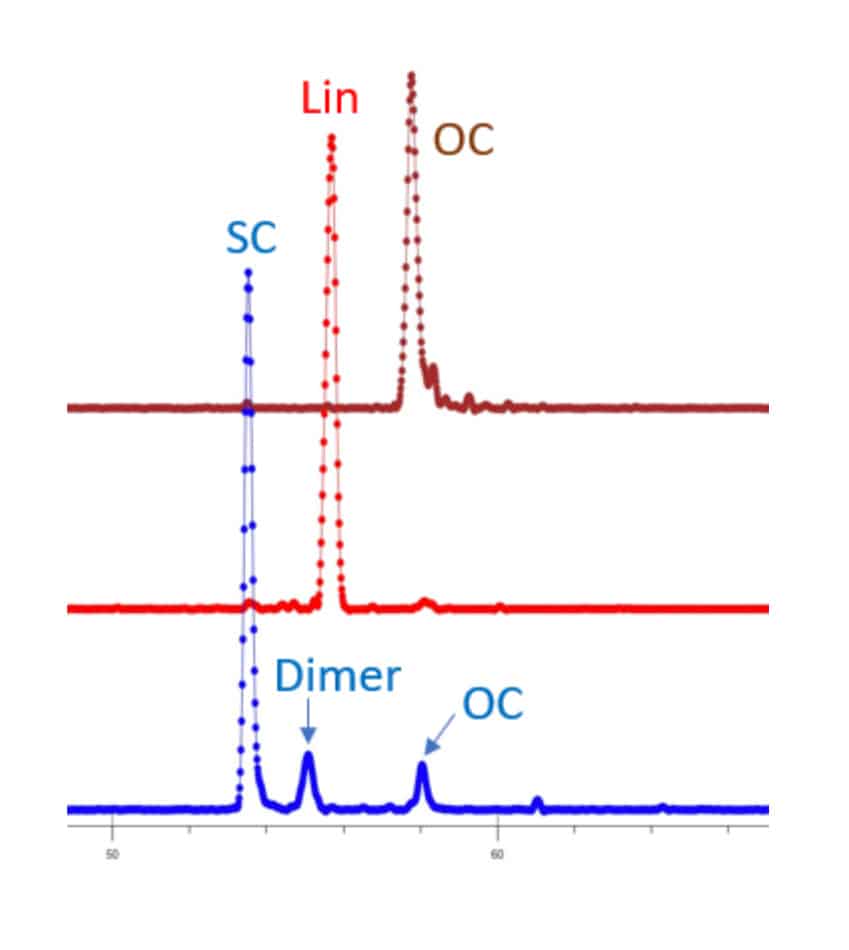
High-resolution separation: CGE accurately separates the main plasmid isoforms: supercoiled forms (SC monomers), dimers, linear forms (Lin), and open-circular forms (OC). Its resolution exceeds that of conventional agarose gel electrophoresis, enabling detailed and reliable topological characterization. Assessment of the linearization rate of plasmids intended for mRNA production: CGE enables precise quantification of linearized DNA, a critical parameter for quality control in mRNA production. Fast, reproducible analysis: less than two minutes per sample, with excellent inter-assay reproducibility. Accurate quantification of monomers, dimers, and oligomers: the method quantifies the different forms to assess plasmid purity and homogeneity. Low sample consumption: only a few microliters are required. Suitable for quality control and R&D: a powerful tool for stability studies, production-process validation, and compliance with regulatory requirements. CGE also enables rapid, high-throughput screening for R&D applications.
Genotyping by PCR
- Préparation du matériel génétique (extraction et purification d’ADNg ou d’ARNm)
- Mise au point des conditions opératoires ou application de procédures validées par vos soins
- Fourniture d’un rapport d’analyse clair et détaillé
- Préparation du matériel génétique (extraction et purification d’ADNg ou d’ARNm)
- Mise au point des conditions opératoires ou application de procédures validées par vos soins
- Fourniture d’un rapport d’analyse clair et détaillé
- Clonage selon la stratégie validée
- Production plasmidique : de quelques µg d’ADN jusqu’à une production large scale
- Contrôles qualité :
- Quantification par spectrophotométrie
- Contrôle du profil de restriction par électrophorèse en gel d’agarose
- Séquençage (insert complet)

- Préparation du matériel génétique (extraction et purification d’ADNg ou d’ARNm)
- Mise au point des conditions opératoires ou application de procédures validées par vos soins
- Fourniture d’un rapport d’analyse clair et détaillé
- Préparation du matériel génétique (extraction et purification d’ADNg ou d’ARNm)
- Mise au point des conditions opératoires ou application de procédures validées par vos soins
- Fourniture d’un rapport d’analyse clair et détaillé
- Clonage selon la stratégie validée
- Production plasmidique : de quelques µg d’ADN jusqu’à une production large scale
- Contrôles qualité :
- Quantification par spectrophotométrie
- Contrôle du profil de restriction par électrophorèse en gel d’agarose
- Séquençage (insert complet)
We provide PCR genotyping expertise to detect specific DNA sequences in your biological samples. Based on the targeted amplification of genomic regions of interest, this approach enables precise and reliable identification of genetic markers, mutations, insertions, and deletions, as well as transgene verification.
This service includes the extraction of target gDNA from your sample (blood, tissue, bacteria, cells, plants, etc.), the design of suitable primers, PCR performance, and verification via electrophoresis and/or sequencing.
Quality control
As part of its plasmid production activities, RD-Biotech offers a comprehensive range of quality-control analyses for both its own products and those of its clients.
Our services cover different levels of characterization and compliance to meet the specific requirements of each project, from research through regulatory-grade production.
Many analyses are performed in accordance with European Pharmacopoeia (Ph. Eur.) methods and standards, ensuring reliable results that meet current quality requirements.
Parameter
Méthodes
Discover our other molecular biology services
Biomanufacturing
Discover our R&D, HQ and GMP grade plasmid bioproduction solutions, as well as our process development expertise tailored to the requirements of each project.
Molecular biology engineering services
Discover our molecular biology engineering services for research and innovation
Plasmid construction
Plasmid construction services for recombinant antibody and protein production, IVT mRNA, viral vectors, gene therapy, and cell line development.